
About Astrology-Ancient science
The study of astronomy has deep roots in our history, with brilliant ancestors laying the groundwork for our understanding of the cosmos. Their contributions continue to resonate in modern science, particularly in our analysis of planetary effects and their implications on Eart
In Indian culture, the Vedas, ancient sacred texts, showcase a remarkable interplay between spirituality and scientific inquiry. They not only provide insights into the celestial bodies but also explain natural phenomena, emphasizing a holistic view of the universe. The wisdom encapsulated in these texts has substantial relevance even today, reflecting a deep understanding of the natural laws governing our existence.
Among the notable figures in this tradition are the Indian Maharshis and Acharyas, who were not just spiritual leaders but also pioneering scientists. Their inventions and theories laid the foundational principles of astrology and astronomy, blending empirical observation with philosophical inquiry. Their works elucidated complex astronomical phenomena, influencing both ancient practices and modern astronomical studies
Overall, ancient Indian science, particularly in astrology, serves as a testament to the advanced understanding of the cosmos by our ancestors. This knowledge underscores the significance of continuing to explore and honor these scientific legacies, which remain relevant in the quest for deeper insights into the universe today.
The history of Indian astrology (Jyotisha) is inseparable from the development of mathematics and astronomy. In ancient India, these fields were unified, with scholars known as Siddhantas focusing on the mechanical calculations of celestial bodies to determine auspicious timing and destiny.
Here is a report on the most influential figures who shaped this ancient science.
1. Lagadha (c. 1200–1000 BCE)
Lagadha is often cited as the earliest known astronomer-astrologer. He is the author of the Vedanga Jyotisha, one of the earliest texts on the subject.
* Key Contribution: He systematized the rules for calculating the movements of the Sun and Moon for Vedic rituals.
* Impact: His work laid the foundational math for the Hindu calendar (Panchang), establishing the concept of the five elements of time: Tithi, Var, Nakshatra, Yoga, and Karana.
2. Aryabhata I (476–550 CE)
While primarily remembered as a mathematical genius, Aryabhata’s work was the backbone of planetary astrology.
* Key Contribution: In his treatise Aryabhatiya, he proposed that the Earth rotates on its axis and correctly explained the causes of solar and lunar eclipses.
* Astrological Link: He refined the calculations for the Mahayugas (great cycles of time), which are essential for calculating long-term astrological influences and planetary positions (Graha Spashta).
3. Varahamihira (505–587 CE)
Varahamihira is arguably the most significant figure in the history of Indian astrology. He lived in Ujjain and was one of the "Nine Gems" (Navaratnas) in the court of legendary King Vikramaditya.
Major Works: Brihat Samhita: An encyclopedic work covering everything from planetary movements to architecture and agriculture.
* Brihat Jataka: The fundamental text for predictive astrology (Hora Shastra).
* Legacy: He was the first to clearly divide Jyotisha into three branches: Siddhanta (Astronomy), Samhita (Mundane astrology), and Hora (Predictive astrology).
4. Brahmagupta (598–668 CE)
Brahmagupta was the head of the astronomical observatory at Ujjain.
* Key Contribution: In his work Brahmasphutasiddhanta, he introduced more accurate methods for calculating the positions of planets and the beginnings of new months.
* Impact: His mathematical proofs provided the precision needed for astrologers to create more accurate birth charts (Janma Kundali).
5. Bhaskaracharya / Bhaskara II (1114–1185 CE)
The author of the Siddhanta Shiromani, Bhaskara II represented the peak of medieval Indian mathematical astronomy.
* Key Contribution: He calculated the time taken for the Earth to orbit the Sun to nine decimal places.
* Astrological Link: He provided complex trigonometry for determining the strength of
planets (Shadbala), which is a core component of modern Vedic interpretation.
Comparison of the Three Pillars of Jyotisha
The works of these masters established the three fundamental branches still used today:
Siddhant: Gives Mathematical calculations of planetary positions. (Aryabhatiya / Surya Siddhanta )
Samhita : It is Collective astrology (weather, wars, earthquakes, economy). (Brihat Samhita )
Hora : It is Individual predictive astrology (Natal charts). (Brihat Jataka / Parasara Hora Shastra )
The Sage Parashara
It is impossible to discuss Indian astrology without mentioning Maharishi Parashara. While often considered a legendary/mythological figure, the Brihat Parashara Hora Shastra attributed to him is the "Bible" of Vedic astrology. It introduced the Vimshottari Dasha system, a unique 120-year planetary cycle used to predict when specific events will occur in a person's life.
The ancient Indian astrologers calculated planetary positions (longitudes) using a system of trigonometry and cyclic mathematics. The primary goal was to find the Graha Spashta (true longitude of a planet) from its Madhyama Graha (mean longitude).
4. Trigonometric Innovations (The Sine Table)
To solve these equations, Aryabhata and Varahamihira could not use modern calculators. Instead, they developed the Jya (Sine) and Koti-jya (Cosine) tables.
The "Ayanamsha" (Precession of Equinoxes)
Indian astrologers also realized that the Earth's axis wobbles. They introduced a correction factor called Ayanamsha to account for the difference between the Fixed Zodiac (Nirayana) and the Moving Zodiac (Sayan)


Our Services
Personalized astrology and vastu guidance tailored for your life and home.
Astrology Readings
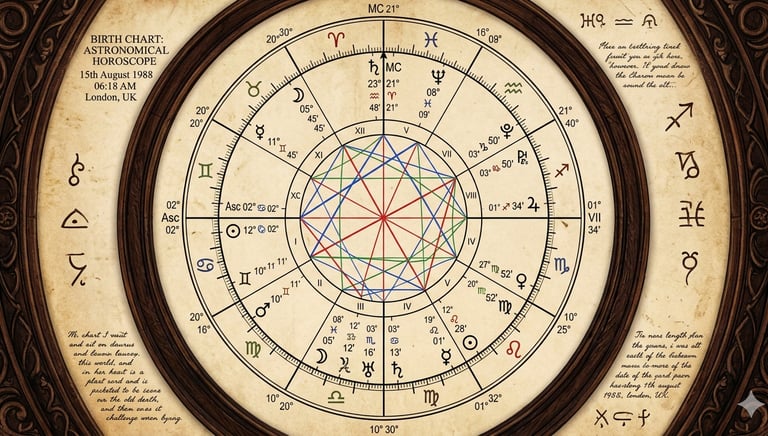
In-depth birth chart analysis to illuminate your path and choices.
Vastu Consultations
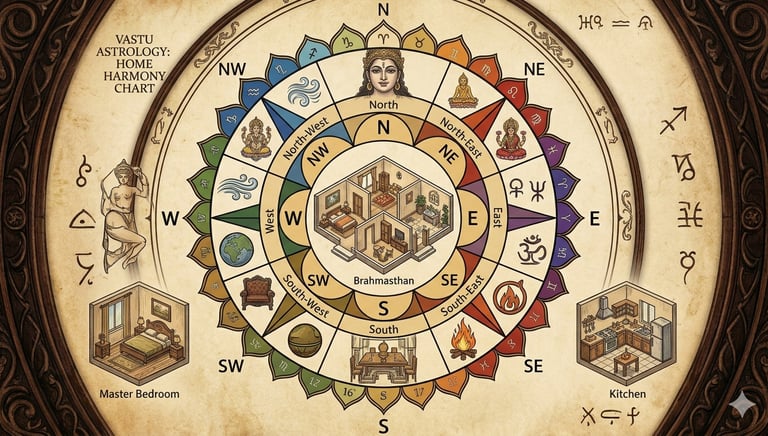
Practical vastu tips to harmonize your living and working spaces.
Stay Connected
Get weekly insights on astrology and vastu